Winter Tree

Tree

My step-daughter, who is an artist, was involved in a project a little while ago which gave her a theme from which to draw.  The theme changed each month (or was it week?) so you had to draw something different each time.  In a moment of foolhardy inspiration I suggested matching her drawing with a poem on each theme.

I am not sure how many themed drawings she did but this poem is my only contribution to the project.  It did give me the idea of writing a poem for each season but this is still the only contribution to that idea too!

Winter Tree

Stripped black twilight silhouette
Charred by blazing rust and gold
Igniting a fiery carpet
Of dead leaves on the ground.

The purifying alchemy of autumn purged
Branches, plundered by untamed Atlantic winds
Thrashing, without apparent purpose,
Then lashed stark naked to the sky.

Darkness doubles, cold ground slumbers.
Fire melts to ice, then rots to rebirth
Until the shroud of winter slips,
To show the fingertips of spring.

Steve Bishop

New Year (2010)

new-year

This really is self explanatory although it does give away my desire to always hear the New Year’s Day Strauss concert from Vienna, the highlight of which is always the Blue Danube. Terribly bourgeois I am sure but a small indulgence in the scheme of things! It always seems to begin the year on a hopeful note.

It was written to mark 2010 but the basics still apply, surely?

New Year (2010)

tabula rasa
blank page
white canvas

dawn light
first kiss
birth cry

bread, wine, coal
food, drink, warmth

thick white silence

blue moon
blue Danube

fresh start

new year’s day

Steve Bishop

Rothko (Tate Modern 2008)

rothko_0_1

Having just returned from a whirlwind visit to London, which included taking in exhibitions by Paula Rego and Georgia O’Keeffe I was reminded of a previous visit in 2008, which included taking in the Mark Rothko exhibition at the Tate Modern. It was probably my first experience of an exhibition which was so massively popular that you could barely move or see the work.

I have been to several since, including Monet, Picasso and the recent O’Keeffe exhibition at the Tate.

It is a bit like seeing one of your favourite bands in a stadium. It’s not the best situation but it is either that or nothing at all. The Rothko visit  inspired this poem.

Rothko (Tate Modern 2008)

Room by room, guided
Through the great man’s imagination,
We do not need our own.
Each pulsating colour, eviscerated,
Every throbbing brush stroke, explained.
Commentary in one hand, notebook in the other,
Wrestling with the unrelenting rhythm of red.

Seagram murals
Stripped of context, re-set and renumbered.
Intensity relaxed,
Density diluted,
Immensity, scaled back.
Guidebooks, handsets, silent colours screaming,
How black is black?
How like black is darkness?

Modern masters strip the layers,
Ravaging ultra-violet reveals the red mystique
Of strokes, glazing, mixing.
Dissection undivided dulls the artist’s voice.

Dimly lit, secretive and alone
The brown gray purple sea at night
Breathes life into the room,
Echoing like the desert blues
Discreet, vibrant and timeless.

Finally framed, black on grays
Betray no bleeding edges.
No knife wounds.
No gashed yearning.

The wind is arctic,
The exit beckons.

Steve Bishop

Don’t Leave Nagasaki

Nagasaki(2)

In the recent debate in the House of Commons on the renewal of the UK’s Trident nuclear submarine capability, the Prime Minister, Theresa May, was asked point blank if she would be prepared to use these weapons of mass destruction. Her equally blunt response was that yes, she would, on the basis that there is no point in having a deterrent unless you are prepared to use it. There is an inexorable logic to May’s position, if you believe that possessing nuclear weapons has a deterrent effect.

There is no evidence that nuclear weapons do deter, any more than there is any absolute evidence that they do not. So the real motivation behind what ever position we take on the issue has to be a mix of the political, the moral and the humanitarian.

The war crimes committed by the United States of America, in dropping nuclear bombs upon the Japanese cities of Hiroshima and Nagasaki in August 1945, have never been acknowledged as war crimes. History, written by the victors as ever, records the use of nuclear weapons as having brought an end to the war in the Far East more quickly. That at least is the generally accepted wisdom. The fact that the war in the Far East was all but over, and the Japanese were on the brink of surrendering to the Soviet Union, an outcome that the United States could not countenance, finds little airspace.

This poem was written last year on the occasion of the seventieth anniversary of the bombings. The Hiroshima anniversary gained much news coverage, due to being the first, while Nagasaki received less attention, hence the subject of the poem.

Since writing this poem I have read the first hand account, Hiroshima by John Hersey, first published in the New Yorker in August 1946 and published as a Penguin paperback, reprinted last year. It is probably the most harrowing 100 pages of journalism you are ever likely to read. You should however, read it.

The debate about Trident continues to be a major political fault line in the UK. Theresa May has been categorical about where she stands. Labour leader, Jeremy Corbyn, has been equally categorical. He is against the recommissioning of Trident and would never, under any circumstances, resort to the use of nuclear weapons.

It is a subject on which we all must decide which side we are on…

Don’t Leave Nagasaki

Little Boy pushed his way to the front,
Had to be first in the queue.
Fat Man groaned as the boy shoved past,
‘Hey son, I was there too.’

In the cold war light the atomic flash
Turned people to shadows on the floor,
Shedding thousands of tears in the seventy years,
Since opening the nuclear door.

Don’t leave Nagasaki burning
With the shame of this regret
Don’t leave Nagasaki wondering
Why no justice yet?

At The Hague they try war criminals
So the world can understand,
But there is no space to try the case
Of the melting of Japan.

The United States stands for freedom,
The United States stands for law.
Is there anyone outside of the United States
Who believes that, anymore?

Don’t leave Nagasaki burning
With the burden of this war crime.
Don’t leave Nagasaki thinking
That there could even be a next time.

Steve Bishop

Note

“Little Boy” was the name given to the atomic bomb the United States dropped on the Japanese city of Hiroshima on 6th August 1945. “Fat Man” was the name given to the bomb dropped on Nagasaki three days later, on 9th August 1945. An estimated 70,000 people died in each of the bombings. Tens of thousands more have died subsequently from burns and radiation.

Poem for Bolt

IMG_20160804_181209

The Olympics are nearly here and, in spite of all of the anti-Brazil propaganda leading up to it, we will all no doubt be cheering on our favourites in some obscure sport, that we are now armchair experts in!

It is hard not to see the whole thing as a commercial scam and with so many drugs cheats it is hard to know what you are watching any more. Also, in spite of the best efforts of the International Olympic Committee, the cultural dimension to the Olympics, the so-called Cultural Olympiad, does not even come a close second to who can run, leap or jump the fastest or farthest.

Which is fine. Who would want a lot of people in shorts running around while you are watching Hamlet? Some things just do not mix easily!

Having said that this poem was written during the London 2012 Olympics, where Danny Boyle’s opening spectacular did at least provide some cultural input. It also coincided with the 50th anniversary of Jamaican independence and the confirmation, if any were needed, that Jamaica’s Usain Bolt is the world’s greatest sprinter.

As you can see from the picture, this was written on the cover of an Observer Magazine which had a feature about Jamaica’s independence, with an inevitable Bob Marley pic. It has been living on the side of the fridge ever since! I was also aiming to write something which would be as quick as Bolt over the 100 metres. That might depend upon how fast you read it!

So here is my Poem for Bolt….let the Games begin!

Poem for Bolt

Lightning Bolt,
Yellow flash on the track,
Jamaica is 50
Marley is back
But Usain’s the name
it’s plain
Is the fastest on the planet,
No one catch him
Again!

Steve Bishop

Gerda Taro (1910 – 1937)

Gerda Taro

In 1936 two young photographers, André Friedmann and Gerta Pohorylle, created the composite name Robert Capa under which they began documenting the Spanish Civil War. The Capa name quickly became associated entirely with Friedmann while Pohorylle took the name Gerda Taro. In the world of photojournalism the name Robert Capa has been internationally known for many years. It is only recently that Gerda Taro has been rediscovered in her own right.

There is a recent book about Taro, Out of the Shadows – A Life of Gerda Taro (2008) by François Maspero, which brings the role of Taro herself back into the public profile, following work by German scholar, Irme Schaber, in the 1990’s. Maspero’s book is flawed in that he spends an inordinate amount of time attempting to ‘disprove’ Taro’s communist associations. Maspero is particularly taxed by the fact that the French Communist Party were able to turn 10,000 people out onto the streets of Paris for Taro’s funeral in 1937. Quite why this should be a concern, at a time when working class support for the Spanish Republic was essential, perhaps only Maspero knows.

Gerda Taro: Inventing Robert Capa by Jane Rogoyska (2013) is the latest contribution to work on Taro, while never missing the opportunity to pounce on an undiscovered romance, Hollywood is on the case with two films in the offing about Taro and Capa

The first major exhibition of Taro’s photography, based upon the research of Schaber, was staged at the Barbican in London in 2008. I wrote the first draft of this poem following that exhibition. Taro’s own work in the field of photojournalism rightly comes to the fore, both in her images of action on the frontline, and in the behind the scenes images of the ordinary people of Spain, caught up in epoch changing events. The Left wing French journals Regards and Ce Soir published many of these photos.

Taro died tragically, just a year after the war started, on 25th July 1937 in Brunete. Heading out to take more photgraphs, the car on which she was riding was hit by an out of control tank. She never recovered from her injuries.

Gerda Taro (1910 – 1937)

Gerda Taro fought the people’s war
With a lens to the left of the action.
Women crouching, pistols pointing,
Volunteers falling in.
Resistance leaders in Valencia
Give speeches of solidarity, frozen
In frames desperate to breathe sound
Into a conflict cursed with silence.

The shadow of Capa kept her cold.
The famous falling soldier
Sealed one reputation
But hid another, just behind the frontline,
Where the unseen action of weeping,
Smoking, laughing and hoping
For victory against the odds
Took place.

These pictures pretend no objectivity,
This is partisan territory.
A plea to break the fence,
To see the people
To help Spain.

This is the art of persuasion.
This is the art of stirring up nation after nation,
This is the art that cries out
Wake up!
‘Don’t you see the blood on the streets?’

Daring to shame the shameless
Ce Soir revealed Spain
To a world not yet familiar
With the backward glance of refugees
Fleeing the fires of fascism;
To a world in denial
Of the furnace yet to come.

Steve Bishop

The quoted line

‘Don’t you see the blood on the streets?’

is from the Pablo Neruda poem, I Explain A Few Things from his collection Spain In Our Hearts, Neruda’s own response to witnessing the events of the war in Spain. It is well worth following up.

The War in Spain (1936 – 1939)

On 18th July 1936 the first shots were fired in what was to become known as the Spanish Civil War. The war raged for three years but could only really be characterised as a civil war for a short part of that time. The presence of fascist troops and armaments from Hitler’s Germany and Mussolini’s Italy, to support the power grab of General Franco, made the war in Spain one of intervention. The intervention was aimed at strangling the newly formed Popular Front government at birth and stopping its influence spreading beyond Spain’s borders.

Less than twenty years after the 1917 Russian Revolution the ruling classes in Western Europe were afraid of communism, or anything remotely like it, gaining a foothold beyond Soviet borders. Initial attempts to overthrow the Bolsheviks by force had failed but in appeasing Hitler, and fuelling German re-armament, the West saw an opportunity to point the fascist forces East and stem the tide of revolution from spreading. Internationally the response of the Communist Parties was, by 1935, to have adopted the policy of supporting peoples Popular Fronts against fascism across Europe.

At a government level the diplomatic overtures of the Soviet Union, to form a united front against fascism in Europe, were rebuffed by Britain and France who proceeded with their policies of appeasing Hitler.

On the ground in Spain the Popular Front policy gained significant momentum in the Autumn of 1935, resulting in the dissolution of parliament and fresh elections in February 1936. The elections resulted in a victory for the Left with a Popular Front majority including 158 Republicans, 88 Socialists and 17 Communists given the mandate to govern. The Right still commanded 205 deputies to the parliament so it was clear that sustaining a government in favour of the workers of Spain was going to be a struggle. As Dolores Ibarruri, in her autobiography, They Shall Not Pass, points out, “…the chief forces of resistance against fascism in the capitalist countries of Europe were concentrating in Spain.”

The honeymoon was all too short lived, with Franco launching his putsch in July, quickly aided by Germany and Italy. How did the Western democracies respond to such provocation against a democratically elected government?

France, with whom the government of Spain had an agreement to purchase arms, refused to sell to the Republican government. Britain and the United States joined in what was to become known as the policy of nonintervention, although this did not prevent US companies supplying Franco with fuel. An estimated 150,000 Italian troops fought in Spain. In Germany 25,000 soldiers received military decorations for the role they played in fighting the Spanish people. Nonintervention was clearly a one sided proposition.

There were however notable exceptions. The Soviet Union did its best to get supplies to the Republic in spite of naval obstruction and the refusal of France to allow supplies into Spain through its land border. Soviet soldiers volunteered in Spain, playing a crucial role as airmen and tank drivers in key battles, especially around Madrid. Some arms were purchased from Mexico.

Recognising the significance of the war in Spain, an influx of Communists and Socialists from across the world made their way to Spain to fight on the side of the Republic, as part of the International Brigades. Their contribution, both in practical and symbolic terms, cannot be underestimated and remains a benchmark of practical international solidarity.

The external forces ranged against the Republic were immense. The Popular Front had little time to establish itself and suffered from weaknesses of leadership and internal division. The antics of the Anarchist FAI and Trotskyist POUM in Catalonia, resulting in an attempted takeover in Barcelona in May 1937, was one such unnecessary diversion from the main battle. Troops from a key front in Aragon were diverted by the FAI and POUM to Barcelona, when retaining the industrial North was key to the Popular Front’s defence of the Republic. The putsch ended in failure but, to the great delight of Franco’s forces, had highlighted disarray in Republican ranks.

In the end however it was not internal differences but the forces of external intervention which brought the Republic to its knees. Italian troops, German airpower and the covert collusion of Britain, France and the United States with the fascists was simply too much for the Spanish people and their allies. By March 1939 the Spanish Republic had been defeated. Five months later the Second World War was underway.

The Man Who Wrote, On Water

IMG00267-20140909-1040

This short story was inspired by a piece of public art outside the International Perfume Museum in Grasse in the South of France.  The city has a century long association with the perfume industry and much more detail than I can possibly convey can be found by following this link to its website at   http://www.museesdegrasse.com/en/history-international-perfume-museum

It is worth a read and the Museum, as well as the city of Grasse itself, are worth a visit.  The picture above is of me outside the Museum in 2014 alongside this fabulous work of public art called The Man Who Wrote On Water.  Bizarrely you will find no mention of the piece on the Museum website.  Foolishly I did not take the artists details or note the exact French title of the work on the basis that, as this is the modern world, as with everything else, you can ‘google’ it.

As a courtesy I would like to mention the artist and give them due credit as my inspiration.  Okay, not a Nobel Prize but I feel they are due some acknowledgement!  Problem is, I cannot find this piece anywhere on the web. My English title draws a blank, while my attempts to use my GCSE level French to get back to the original title are not helping either.

Quite possibly I am missing something obvious so if anyone out there can help with the original French title or name of the artist, let me know.

For now, here is the story…..

The Man Who Wrote, On Water

It seemed like a good idea at the time.  One of seven artists, each challenged to come up with a piece, on water.  Or so he thought.

In retrospect he could see that the wording was ambiguous:-

Seven new talents required to write, act, dance, paint, play or otherwise perform, on water.  No previous experience required.

He set to work immediately, honing perfumed phrases, making endless trips to the harbour.  At the quayside he calculated the flow and rhythm of the river, its rise and swell from the passing ships, the sound of its lapping against the ferry landing.

Having advanced his name he was delighted to quite quickly find an acceptance in the post.

Please attend at such and such a place, on such and such a date, at such and such a time, being prepared to write, on water.  Dress code: smart casual.

Smart casual?  The requirement was strange for a writer but, determined to make a good impression, he had the second of his two decent suits dry cleaned.

Inspired by the prospect of publication the words began to flow even more freely.  A cascade of words, a waterfall of words, an ocean of imagery.  Nothing could stem the tide of his imaginative outpouring.  In short, his creative cup was overflowing.

The day arrived.

He entered a building of luminous yellow and, having made his enquiries at reception was directed into a waiting area with all the personality of a government department, formal noticeboards, laminated instructions and not a drawing pin out of line.

He had arrived promptly and expected that, whatever form the interview might take, he would be able to come and go anonymously without meeting the other candidates.  Within minutes however six others had joined him, each displaying that uneasy mix of enthusiasm and fear, characteristic of those edging towards the unknown.  The room bristled with anticipation.

Each greeted each with polite nods and a certain sense of uncertainty.  How would these artforms mix?  Some form of anthology, or video diary?  A performance piece perhaps?

Nothing had been requested in advance but it was clear that all seven were in a state of readiness and preparation.  The papers containing his notes, poems and prose pressed heavily against his chest inside his suit jacket.  It was tighter than he remembered, having confined its use to the occasional wedding, funeral or interview occasions.

At last the first name was called and an unkempt youth sprang to his feet then through an open door, as indicated by an assistant.  From the other side of the door muffled voices, silence, then a brief exchange.

The young man emerged, evidently flustered, with his right arm wet up to the elbow, shaking his head.

“They have got to be joking, man!”

he blurted, to no-one in particular, before hastily leaving the building.

The remaining six exchanged bewildered glances before a second name was called.  A smartly dressed woman moved tentatively towards the door.  The assistant smiled benignly, the woman edged past her nervously.

In the waiting room it was possible to hear a similar routine being played out behind the door.  Tension around the room increased.  The woman emerged, red-faced and exasperated, shaking her wet left arm.  She quickly smoothed her skirt then left without a word.

Twice more similar performances followed with equally baffling results.  Whatever the interview process, the candidates did not appear to be measuring up!

Two men and two women had ventured and returned so far.  He looked at the two women who remained in the room with him, trying not to be conspicuous about the fact that he was looking at them.  Exchanges between the women over the course of the proceedings so far suggested that the two knew each other, or at least had met before.

The first, upon being called, gave the other a hug, which was reciprocated along with a warm,

“Good luck.”

before the assistant, now taking on something of the aspect of a guardian at the gates of Hell, guided her through the door.

This time the voices were raised more quickly and the exchanges were sharper.  The woman emerged, this time with both arms wet, and declared to her friend,

“I’ve done yours too.  Really, it isn’t worth it!”

Shaking both arms she headed quickly for the exit, pursued by her friend, leaving him alone in the room.

Moments later the assistant emerged and, upon seeing him alone, an eyebrow quivered slightly in silent supplication.

“She’s gone”, he said, stating the obvious.

“Okay”, she replied, “we’ll just have to take you then.”

He reflected briefly on the woman’s lack of people skills but decided against saying anything for fear of prejudicing his chances.

He stood up, feeling uneasy in the underworn suit and followed her through the door.  He touched the papers in his inside pocket as he passed through into a huge amphitheatre space.  At the back of the hall was a makeshift desk, behind which sat three officials, pens poised.

This much he had expected but, just in front of the desk and the officials, was a far stranger site; seven ceramic baths lined in a row.

Looking at them from left to right he noted that the first five baths were empty, having been drained of their contents.  The sixth remained three-quarters full, while the seventh, like the first five had been drained dry.

“Bonjour,” chirped the officials in unison, “Asseyez-vous, s’il vous plait.”

French?  He thought, why this?

“Parlez-vous francais?” asked official number one.

“Un petit-peu”, he responded uncertainly, feeling his chances of success beginning to drain like the empty baths.

“Perhaps we proceed in English then?” suggested official number two.

“Peut-etre,” he replied, much to his surprise and the bemusement of the officials.

“English it is then,” concluded official number three.

That settled, the initiative passed back to the first official, who launched into what was clearly a well rehearsed script.

“We are here on behalf of the Artist,” he began, “whom we have commissioned to create an iconic piece of public art.”

The ‘creation’ of icons troubled him, they should surely emerge over time?  However, he kept quiet.

“The Artist has a concept,” continued number one, “about the ephemeral nature of art, indeed all creative endeavour, and is looking to represent that concept through this scene.”  He waved expansively to indicate the baths.  “Each of these bathtubs represents a different artform,” he continued, “and the Artist will work to deliver his message through these images.”

He considered the somewhat disconsolate array of empty tubs in front of him, wondering exactly what ‘message’ an unsuspecting public might finding winging in their direction.

“Seven”, said number two, as if reading his thoughts, “Seven is a number with metaphysical significance.  The seven deadly sins, Shakespeare’s seven ages of man for example.”

“Dante’s  seven circles of Hell”, offered number three, to his colleagues’ obvious chagrin.

Very literary, he thought.

“Six of the seven artforms have so far disappointed”, number one again,   “they seem to have failed to grasp the concept of the Artist.  Their tubs, as you can see, are empty.”

He stood up and walked down the line of bathtubs.  Number two picked up the commentary as he passed the first tub.

“Painting, what is there to say after Warhol?  Once it became clear that this art is not art, but product like any other, it is no longer important.  Okay you have the rare exception, like Banksy, but Damien Hirst?  Tracey Emin?  Margaret Thatcher in an unmade bed!  Dry, as you can see.”

Hard to argue, he thought.  Number one picked up the thread at the second tub.

“Acting, no creative input or personal interpretation any more.  All about the effects, the box office, the lowest common denominator, also dry.  The lost art of photography,” continued number one as he passed the third tub, “surpassed by the digital revolution, democratised to the point of being meaningless with iphones and ipads.  Anyone can take a photo now?  But what about composition, meaning, impact?  Show me the new Gerda Taro or Robert Doisneau.” 

“Dance”, said number three at the fourth tub, “can anyone really understand it?”

These boys are not pulling any punches he thought, as he reached the fifth tub wondering what would be in store next and for whom.  It was not long in coming.

“As for music”, number two picked up the baton again, “the worst offender!  Oozing indiscriminately from every shopping mall, car and street corner, reduced to a catalogue of digital sequences.  Virtually anyone can press a few buttons and become a millionaire overnight!”

“Yeah, keep the beat and you can stay in the seat!” chipped in number three.  No one laughed.

Passing the sixth tub he was waved on briefly to the seventh.

“Video film making”, said number one.

“Not even an artform is it?” came back number two.

“Don’t know why it’s there”, added number three.

He stepped back slightly and positioned himself behind the sixth tub, finding his voice at last.

“So, what is it that you have in store for poetry and literature?”  he asked.  “Surely no one can measure up to the great artists of the past.  We have no Shakespeare, Brontes, Cervantes or Dante. We have no Bertolt Brecht, Doris Lessing or Pablo Neruda on the horizon.  Where is the new Maya Angelou?  Will we find a new Toni Morrison when the time comes?  Gabriel Garcia Marquez……”, his voiced trailed off as his arms opened wide to provide the missing question mark.

The officials looked as though they were about to burst into a round of applause but in a collective effort of bureaucratic restraint, prevented themselves from doing so.

“These are the very questions to which we need answers”, beamed number one, “your colleagues all failed to see that point, hoping that they had been invited here to fulfil some commission or compete for some ill deserved award.  The Artist has asked for an interpretation of the current state of their art from each of the invited artforms, using the bath and water provided.  Most, simply pulled out the plug.”

“The video woman didn’t event do that”, chipped in number three, “her mate pulled the plug for her.”

Very telling, he thought.

He looked across the six empty baths and contemplated the full tub in front of him.  He had not met the Artist but knew some of his work and would be suitably flattered to feel that he had contributed to an important piece, should the public accord it the hoped for iconic status.  On the other hand, the time and effort put into creating the poetry and prose, on water, would appear to have been wasted.  There would though, be other opportunities for his writing, there may not be other chances to make a symbolic statement about his craft.

He looked each of the officials in the eye.  They met his stare and awaited his response.

“Poetry and literature are immersive experiences”, he declared as, fully clothed, he stepped into the full tub of water before him.

Unbuttoning the too tight suit, he felt the water fill his boots and creep into the pockets of his trousers as he sat down.  He could feel the pockets of his jacket fill as, draping his left arm over the side of the bath, he waved his right index finger over the rising water, in shapes that only he could understand.

Steve Bishop


Cardigan

This is a poem about having to let go of something you know you will really miss.

Cardigan

Mustard coloured and worn,
hanging on a peg by the back door,
your tattered comfort has seen
us through the years’ chills.

Retrieving chives from the garden,
nipping out, arms laden with re-cycling,
scampering to gather logs
for a winter blaze.

Too tattered to take out dancing,
too old to grace the winter shows,
you quietly accept the substitute’s role
uncomplaining and, until now, constant.

This further snag though, may be the last
as your reliable threads unravel,
at a speed with which
only the ever present
are free to vanish.

Steve Bishop


The Candidate of No-Hope

USpoverty2

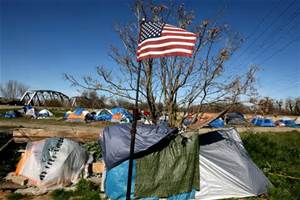
This is a piece of unashamed agit-prop, “what’s new?” I hear you cry!

This piece came about by accident.  If you are not familiar with the latest set of songs by P J Harvey, The Hope Six Demolition Project, you really should be, it is a great album.  The opening track The Community of Hope is a tirade against failed efforts in the United States to address inequalities in poor communities.

The song concludes with the line

They’re gonna put a Walmart here

which, on my initial listening I misheard as

They’re gonna build a wall marked fear

thinking it was a reference to the current US presidential campaign.  Undeterred, I thought the misheard line was worth holding onto, although I wasn’t sure quite how to use it.

Eventually I got to the point where I had to do something, so decided to take the entire P J Harvey song structure and work up a different set of words.  The title, The Candidate of No-Hope, came quite quickly and, once started, the rest began to fall into place.

I have made one or two tweaks to the original structure so it does not follow absolutely line for line but follows the basic pattern.  I have one great hope and one nagging fear about this poem.  The hope is that P J Harvey will read it and think it so great  that she will use it too (unlikely), the fear is that P J Harvey will read it and sue for plagiarism (more likely).

Likelier still, P J Harvey will not read it, nor will it have any impact upon the US presidential campaign.  It might get a couple of people to check out The Hope Six Demolition Project though.  That at least would be a positive result.

The Candidate of No-Hope

Here’s the brushed back redneck hopeful
Unspeakably, his lies unfold
At a pace too fast for America
To realise, it is being fooled.

Here’s the test to liberal resistance
Putting all Muslims on ice,
While punishing women for abortion,
It’s God’s work, so why think twice?

The Candidate of No-Hope
Manipulates the down and desperate,
Preying on fears without shame,
While schools and hospitals crumble,
In his cynical political game.

Here’s the man to trump the establishment
Cutting through their political base,
Home of the brave as political monster,
One hand on the nuclear case,
The Candidate of No-Hope.

They are going to build
A wall marked fear.
They are going to build a wall
Marked fear.
They are going to build a wall marked
Fear.

Steve Bishop

Le Père Lachaise

pere lachaise

I have visited Paris many times over the years and established a tried and tested route around the city.  There are variations on this route and wanderings off the path but it largely involves the Pantheon, the Rue de St Geneviève de Montagne, the Marais, Notre Dame, St Sulpice, St Germain de Pres, Boulevard St Michel and the fabulous Luxembourg Gardens.

The Canal St. Martin and Place de la Republique have also featured as perambulations have widened.  Most recently, the discovery of an area wonderfully known as the Enfants Rouge, has added a new dimension to the city.  All of the above still only touches about five of the city’s 20 arrondisements.

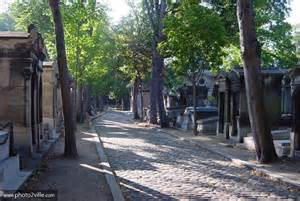
Slightly beyond all of these, in the east of the city is the cemetery, Le Père Lachaise.  It sounds like an unlikely tourist destination but is a must for the mildly macabre and the massively curious alike.  Cemeteries  are the encapsulation of local history and are quite simply the great levelers.  No matter how grand the monument or elaborate the shrine, the end is still the same for pauper and prince.

On one level though the best cemeteries are not unlike a museum visit, a museum of public art, reflecting changing taste and priorities down the decades.

Le Père Lachaise is a fabulous example of this.  Ranging from its nineteenth century bourgeois families to the twentieth century celebrity of Jim Morrison of The Doors, or the literary shrine to Oscar Wilde, previously covered in kisses but now ‘protected’ by Perspex paneling.

I had anticipated this much but not the monuments to the heroes of the resistance to Nazism, or those commemorating the victims of the holocaust.

This poem reflects the impact of that initial visit.  Of all the things crying out to inspire an aspiring writer in Paris, I would have to end up with this!

Le Père Lachaise

The moon cries red until at last
Time spins our hearts along the track.
Galleries and fashion houses fade,
Gucci turns to grey, grande to gauche.
Washing lines, tenements, unseen Paris,
Then silence comes to rest
In Père Lachaise.

Hearse worn cobbles suffer tourists,
Gravestones struggle for a view.
Death, mapped out in five languages,
Directs us with quiet whispers
To names and families,
Marble and gilded monuments.

The famous beckon, inviting adulation.
Wilde with kisses, adored,
Unrepentant, crushed by time.
Piaf, petit, discreet, cascaded in petals.
Morrison, mournful, macabre,
Guarded against dangers beyond death.

But who can be a tourist
In the city of the dead?
Whispers, rise slowly to a scream.
The unburied dead surprise us,
Silent statues stinging tears.
Auschwitz – Dachau – Bergen-Belsen –
Here stand our hostages to fortune.

Screams die falling into city noise,
Senses re-awaken, mixed and strained.
Aching hearts, touch lonely terrors.
The smell of the past is burning,
The present tastes of sweat and sex,
A flicker from the future sees children,
And hears the sound of birds singing.

Steve Bishop