Yet Another Country

Only the sound of birdsong
And the rumbling drone of bees,
Breaks the crushing silence.

There is no electricity in the air,
No distant hum of traffic,
No diesel fumes.

Venues echo with the sound of unplayed music,
Theatre stages, empty with unperformed plays,
Cinemas stack spools of unscreened film.

Bars and restaurants, bewildered,
Café street furniture redundant,
There is no match day buzz of hope.

City streets are shuttered and haunted,
Populated by trespassers
Shopping furtively.

The police look on, vigilant for new crime,
The inessential journey, unnecessary visit
Or unwarranted expedition.

Is this face-masked frightened nation
A vision from the future which,
Just like the past, is yet another country?

Steve Bishop

Zooming

No one is impressed by The Godfather poster
Or your Fornasetti paper design.

Who wants to see mock Tudor beams,
Or bookshelves that heave,
In the way we now dream, with
Magic realist South American lives?

No one cares for orange wall rustic,
On screen it just hurts your eyes.

Careful presentation, modern-day fiction
Dramatises the everyday life
That we all view, sitting in judgement,
Smug spies for an hour at a time.

No one dares to seem any less than cool,
Ethnic art comes as no surprise.

What would we give for a hairdresser,
Or an over priced objet d’art store?
Who would not pay for the beach for a day,
Or some rich guys kicking a ball?

No one craves these interior glimpses
Over real live bodies and breath.

Suspended, we now zoom in on
Worlds confined to a room,
Waiting for that dash to freedom,
Desperate for the right to roam.

Steve Bishop

Life During Lockdown

Life During Lockdown

See that van, loaded with shopping,
Packed up and ready to go.
We buy our goods, we keep our secrets
In places nobody knows.

A siren sounds, off in the distance
We’re getting used to it now.
The empty parks, the empty beaches
They’re the new normal somehow.

Gone are the parties and all the discos
No one is fooling around.
No one is dancing or lovey-doving
They don’t have time for that now.
 
Send out a message, to meet in screen time
Hope we can catch the delay.
Moaning and bitching, on social media
Where you can hide your real name.

Their propaganda, comes to us nightly,
Autocues ready to scroll,
Where does the truth lie? What is fiction?
We may not ever get told.

In darkened depots, while trucks are loaded
We’re getting ready to walk,
Blurring the night time, into the daytime
Living our lives in the dark.

Burning down houses, we burn up notebooks,
Burn with the will to survive.
We strive for light as we speak in tongues
Yet, this burning keeps us alive.

 Steve Bishop
(with thanks to Talking Heads)


The Honest Ulsterman

20th January 2018

Irish poet, James Simmons, established The Honest Ulsterman, a literary magazine for new work by Northern Irish poets and others from around the world, in May 1968.  It was published continuously from then until 2003.  Early issues included work by Stevie Smith, Tony Harrison, Gavin Ewart and Seamus Heaney.

The magazine now continues in an online form (http://www.humag.co/), its home page summarising its origins as follows:-

“The magazine was created by the late poet James Simmons in May 1968, when Paris was teetering on the brink of revolution and Northern Ireland civil war. It was subtitled “A Handbook for Revolution”, in response to which the RUC raided the printers, failing to comprehend that a revolution might be a poetic rather than a Republican or Marxist one. Instead, Simmons had hoped to bring about a revolution in the way we view the world, beginning with our own… “

In August 1969 Issue 16 was published, retailing for a mere three shillings, it looked like this, featuring new work by, amongst others, Gavin Ewart and Brendan Kennelly:-

HUpic

Issue 16 is however notable for another reason.  On p21 it contained the first published work by budding North East hopeful, Brian Topping, a short piece titled In A Dead Factory.  In spite of the 40 year hiatus since such an auspicious literary start, more recent work has been worth the wait.  However, as a piece of North East literary history, this is still hard to beat.  Enjoy the journey!

Steve Bishop

BTpic

Freedom City

31st October 2017

DSC_0739

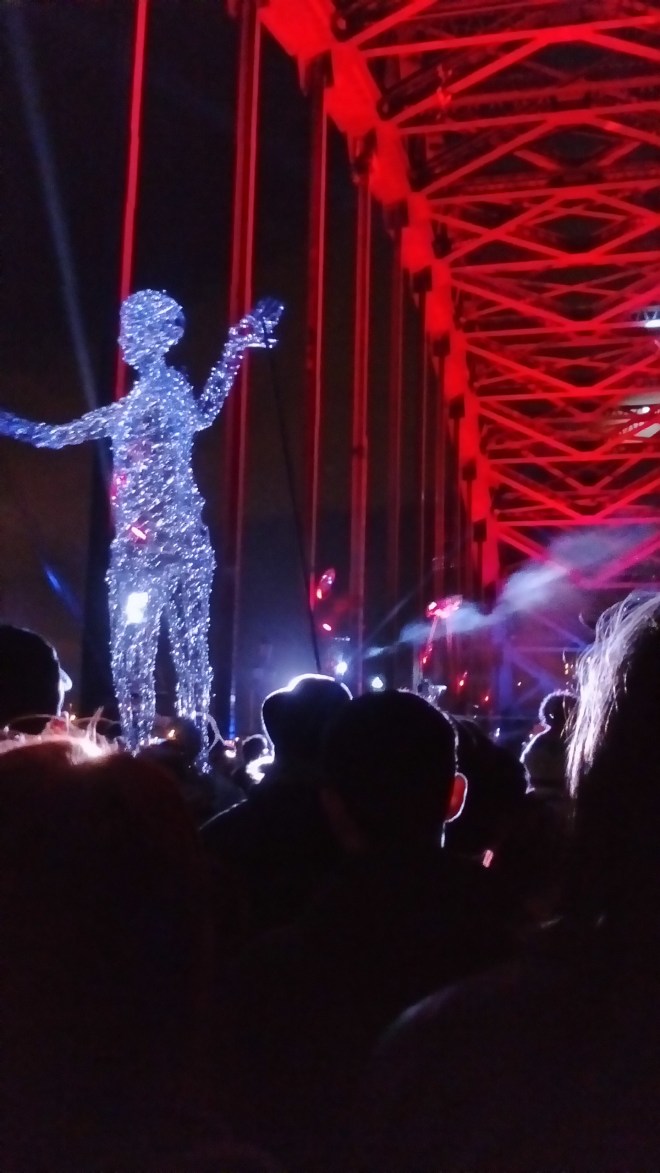
On 29th October I stood on the Tyne Bridge watching the moon peek through the lattice of the bridge as the words of Martin Luther King rang out to the thousands gathered to mark the 50th anniversary of his visit to Newcastle.

Earlier in the afternoon I was part of the crowd gathered around Grey’s Monument in Newcastle to witness a dance and theatre performance to mark the 50th anniversary of Martin Luther King being awarded an honorary degree from the University of Newcastle.  The University was the only one in the UK to make such an award to Dr. King in his lifetime.  The events were part of Freedom on the Tyne, one element of Freedom City, a series of events across the year organised to mark that occasion and struggles worldwide against racism, poverty and war.

The performance was one of five across the city which highlighted flashpoints in the struggle against injustice, the Amritsar massacre in India in 1919; the Peterloo massacre in Manchester, in 1819; Sharpeville in South Africa 1960; and the Jarrow March in 1936.  The performance at the Monument marked the occasion of the march across the bridge in Selma, Alabama USA in 1965, when civil rights demonstrators were shot by Alabama state troopers.  Images of violence from that march shocked the world and forced the Alabama authorities to permit a further march, led by Dr. King, which helped change the course of the civil rights struggle in the United States.

As well as identifying the historical importance of the civil rights movement, the performance stressed the ongoing issue of the killing of young black people by the police in the United States. This has resulted in the increasingly vocal Black Lives Matter campaign and the controversial protests of many black American athletes, refusing to stand for the national anthem at major sporting occasions.

As the crowds continued to swell the performance reached its crescendo, echoing the words of Dr. King against racism, poverty and war.  With the performance over at the Monument, the crowd began to move down Grey Street, along Shakespeare Street then onto Pilgrim Street towards the Tyne Bridge.  Performers and crowds from across the city were converging on this single point, symbolic of the bridge in Selma, and the setting for a spectacular aerial display and rousing finale of light, music and performance, in which all struggles were joined.

I was taken back in my memory to another bridge in Newcastle, almost forty years ago, when a callow youthful version of myself boarded a bus destined for London.  I was embarking upon a journey which I thought would be one of seven hours, to be part of the Rock Against Racism gathering in Victoria Park in April 1978, to be part of a national protest against racism, poverty and war.

Almost forty years on that journey continues.  There are still many bridges and many rivers to cross.  However, as the many issues highlighted by Freedom City show, with the continued collective steps of us all, it will be possible to reach the other side.

Steve Bishop

For more information on Freedom City visit freedomcity2017.com

I don’t really understand astrophysics

Another piece from Brian Topping, which starts off with a statement for its title and  ends up with a question, all in the space of fifteen lines.  For some reason I was reminded of the Alexei Sayle joke “I have given up asking rhetorical questions.  What’s the point?”  It may not be a fair comparison but the poem does challenge the way reality is constructed.  See what you think.

Steve Bishop

I don’t really understand astrophysics

I recently read
that space is not just space
the gap between
one solid object and another
it’s made of minute particles
so small they can’t be seen
they are not IN space
they ARE space
they can bend or stretch or both
this theory follows
two incompatible theories by Einstein
as he said
it’s weird
possibly like poetry
but I understand poetry?

Brian Topping

Homelands

Ghayil

I have been fiddling about with this poem for some time, trying to get the right feel and tone.  It has taken a long time just to settle on a title.  It started out life with the working title Are You Glad to Be in America?  This is a direct lift from the James Blood Ulmer song of the same name, so was never going to stick, but it seemed apt for a while.  There is certainly some reference to raining and Cadillac cars in there, which I may well have sub-consciously ‘sampled’!  Check it out on You Tube here https://www.youtube.com/watch?v=rnYKh72NXig

It then lived for a while with the title Ground Zero but that didn’t really fit the bill either.  The poem is not directly about 9/11, or a response to it.  It is more of a response to the response of the West to those events but an attempt to set them in a wider historical context.

The current title has, as an obvious reference point, the US TV drama Homeland, which my wife insists has now run out of ideas, but I still find the storylines sufficiently ambivalent to keep watching!  While Homeland is invariably focussed upon homeland security issues in the United States, the idea that there are many homelands suggested a fitting title for the poem.

Homeland security for some is still rocks and stones, rather than a nuclear arsenal and the might of the world’s greatest army.

Homelands

Raining glass over Cadillac cars,
The Statue of Liberty screaming.
Murmurs shake the heart of capital,
Manhattan’s sky stains red.
Is this Baghdad or Damascus,
Where missiles cruise, widows cry
And buildings shatter in the heat?
Or is this modern day America?

When victims have no name tags
The West keeps a wary distance.
One more battle in a war of the past,
Casts shadows across the night.
Break the family entertainment.
Faces and places too hard to name,
People, too frenzied to sway,
Play to an empty room.

How the free world loves America
Where the dream lies, buried and crushed.
They pity and avenge those homes
Of the brave, justify the unjust.
Collateral damage Ground Zero payback,
Precision bombing
Mountains, hills and caves,
Painting dark the dreams of children.

In the shadows of Hiroshima,
In the napalm fallout of Vietnam,
In the wailing women of Palestine
The wretched are starred and striped.
This crusade is now stripped naked,
The challenge to choose our sides,
In this new world, where dollars fall
From oil black bomb filled skies.

Steve Bishop

shadows and silence

After the initial batch of three poems, published recently, from Brian Topping there was always the possibility of more and we have not been disappointed. Three poems have landed in the inbox to add to the recent contributions. This time however there is the chance to savour each independently. The first follows…

Steve Bishop

shadows and silence

the cold silence of rowing boats tied
on a holiday lake in winter

the threatening silence of failure
in a deserted open roofed factory

the swaying silence of swings
in children’s playground at dusk

the uncertain silence
of a trunk road at 4am

silence in the memory
of unknown couples

this is the silence of split seconds
where shadows can’t form

the silence denied then welcomed
like your shadow on the stairs

Brian Topping

Three Poems

My long time friend and some time mentor, Brian Topping, surprised me recently by revealing that he turned his hand to the occasional poem.  Had for many years.  Even had something published in a journal edited by Seamus Heaney in his younger days.

Clearly I had to see something. So Brian sent me three quite different but equally thought provoking pieces.  Here they are, who knows, there may be more……

Steve Bishop

Assassinating Sooty

it was always an unlikely mission
after all Sooty is inanimate
unless
like a vet helping a pregnant cow
someone
anyone
puts a hand up his arse
it gets worse
his voice  edges on silent
his nose has to be in your ear
to make himself heard
he is also cute
super cute
his demise
would provoke Dianna scale grief
it is mission impossible
so I have given up
killing innocence
and retired into adulthood

(for William Blake)

Post-industrial dawn chorus

Hearing the blackbird
I felt for a moment
like nothing else existed
one of those moments
when the past is not a reality
the future no longer a concern
such moments
lock out light and dark
transform the precious present
then he stops
I stop
return to my coffee
and the concerns
of being awake too early

Palestine video

this seems unreal
but the evidence
..the reality is here
rockets..
…..grenades
tank shells..
…..bullet casings
broken children..
…..crimson sand
pan left pan right
no wind
weeping flags

Brian Topping

A first taste of Cuba

1st June 2017

Raul Castro May Day 2017

 photo: Raúl Castro greets the May Day crowds

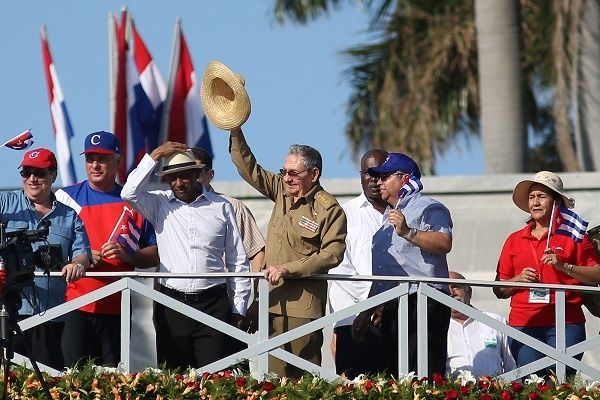
Just a month ago I had the honour of being present in the Plaza de la Revolución in Havana, Cuba for the annual celebration of May Day.  Not 250 metres behind me Cuban President, Raúl Castro, was up on the rostrum, doffing his straw sun hat or waving a small Cuban flag, as hundreds of thousands of Cubans and international guests paraded before us.  Castro was not surrounded by hordes of security service operatives or armed police.  His presence was relaxed and natural.  The assembled guests below, myself included, would occasionally turn to offer a wave or cheer in solidarity and receive an acknowledgement before we all turned to focus upon the incredible sight below us.

The first May Day since the death of Fidel Castro, in November 2016,  and perhaps the last with any Castro in a position of authority in Cuba, Raúl has stated more than once that he will step down in 2018, was running smoothly as planned.

As part of the Cuba Solidarity Campaign May Day Study Tour 2017, this was my first time in Cuba.  The May Day rally itself was the centrepiece of a tour that included a wide range of meetings at health, education and agricultural projects as well as visits to key cultural centres.  As an introduction to the country, it was an excellent way to both see Cuba and to understand the context in which this Caribbean island of 12 million people, only 90 miles from the United States, has to function.

Che with Crowds

photo: May Day 2017 Havana

There is a misconception that, due to the thaw initiated by Raúl Castro and then US President Barack Obama in the 2013 – 2015 period, relations between the two countries are now on a normal footing.  It is true that there has been some change.  In July 2015 the Cuban embassy reopened in Washington D.C., for the first time in 54 years, and the following month an American embassy was re-established in Havana.  Previously, each country only had a “special interest section” in the other country.

However, there are still key issues outstanding between the two countries.  The most significant of these is the ongoing illegal economic and financial blockade of Cuba by the United States.  The blockade has been in place for nearly sixty years and has a significant impact upon the ability of Cuba to both export and import on the international market.  The US will not allow Cuba access to the dollar for example, the currency in which most international trade is conducted, thus forcing the Cubans to find alternative ways to trade, through third parties, in order to sustain the economy.

Also, the United States persists in its illegal occupation of the Guantanamo Bay naval base, made famous worldwide for the detention of terrorism suspects, in order to retain a military foothold in Cuba.  Given the recent change in the administration in the United States there is little hope that the issue of the blockade, or that of Guantanamo, will be addressed soon.

The blockade, in particular, featured at various times in our discussions.  In terms of the health and medical sector, the blockade restricts access to many vital drugs and medicines.  However, the converse impact has been that Cuba has had to become more self reliant and generates 80% of the pharmaceuticals it requires internally.  Agricultural machinery, which could be sourced in Mexico, has to be imported from other parts of the world, adding to transport costs and the logistical problems of sourcing spare parts and expertise.

Against this background Cuba has made great strides as a developing country.  There is a universal health care system, free at the point of use, and able to boast an infant mortality rate of 4.2 per thousand live births, to rival that of the UK at 3.6 per thousand live births.  Latest World Health Organisation statistics put the United States figure at 6.5 per thousand live births.  Given the inequalities in wealth and health provision across the United States that figure will undoubtedly mask significant differences in areas of high deprivation.

IMG_2263

photo: Discussions with medical staff

Cuba places great emphasis upon training for the medical profession, with staff employed across the Cuban medical system and thousands of medical professionals deployed in other developing countries, in order to provide them with much needed support.  In the region of 15,000 Cuban doctors are serving outside of the country.

Discussions we held with medical staff in Pinar del Rio and Viñales made clear that the community based emphasis of the services is vital to the well being of the population.  The family doctor, at the core of a team based in each community, can draw upon specialist expertise at the district level, where necessary, and at a national level if needed.

Education provision, right through to University level is free across the country.  The level of literacy in Cuba is 100%, a level established initially in 1961.  That year was declared by Fidel Castro as a year to combat illiteracy in Cuba, then running at 20%, and teams of young people from the cities spent the year in many rural homes, where illiteracy was rife, to tackle the problem.  The Literacy Museum we visited was a testament to the significance of this campaign and underlined the ongoing importance of literacy and literature in Cuba today.  The 1961 campaign culminated in all of those who had participated marching through Plaza de la Revolución in Havana wielding massive pencils, a fabulous image!

Cuba spends 48% of its gross domestic product on health and education services, a clear indication of where the priorities of the government lie.  The UK equivalent figure is 29%, which tells its own story.

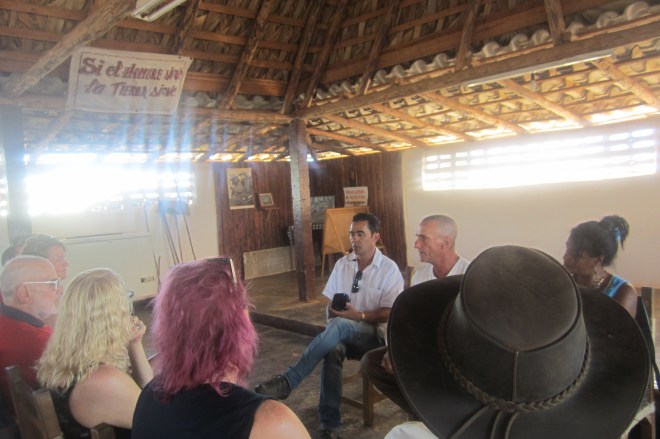
Economically Cuba is tackling the issue, common in many parts of the world, of de-population from the countryside.  At the time of the revolution in 1959, 80% of the population lived in the countryside and worked in agriculture, with only 20% living in the cities.  Those figures are now exactly reversed.  In part, this is due to the success of the Cuban education system which means that, unless young people are training as specialists in agriculture, they inevitably gravitate to the cities and professional occupations.  Our discussion at the agricultural co-operative, in Viñales, centred on the impact of this shift and policies to combat it.
IMG_2227

photo: Republicca de Chile Agricultural Co-op

One initiative from the government is to promote land lease arrangements to encourage more people to return to the land in order to redress the imbalance in agriculture.  It is too soon to evaluate the impact or success of this approach but more people working the land will be vital to maintaining economic balance.

At the same time, a great deal of emphasis is being placed upon tourism as a foreign currency earner for the economy.  This inevitably requires far greater engagement with the private sector, both at a macro and at a micro economic level.  On a macro level this means attracting investment from companies such as Spanish hotel giant Iberostar, who have now built 14 hotels in Cuba, in order to bring in the knowledge and expertise required to cater for growing numbers of Western tourists.

At a local level the plethora of artists and musicians across Havana, the growing number of restaurants and the constant stream of sellers of Che Guevara paraphernalia, are an indication of increasing levels of local entrepreneurship.  A new fleet of bright yellow taxis outside the José Martí International Airport in Havana were a further indication of the government drive to support the tourism economy.
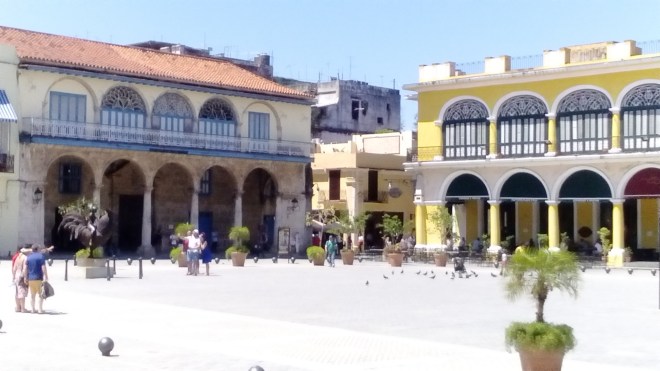
DSC_0375

photo: Plaza Vieja

The drive to attract tourists is combined with a major programme of building restoration across Havana.  In places such as the Plaza Vieja, where much restoration has been completed, the buildings look fabulous, returned to former glory.  In other parts of the city, there is clearly still work to do.  The US blockade however is a factor here too, slowing down access to the materials required to make progress at the pace the Cubans desire.

While earning much needed foreign currency, tourism is potentially a double edged sword.  The growth of the private sector, if not carefully regulated, has the potential to generate differentials in earnings, which may undermine the social gains of the revolution.  We were assured that Cuban trade unions are aware of this and are actively recruiting in the private sector.  The next decade will be critical for Cuba in ensuring that the social gains of the revolution are defended, while the economy is expanded.

There are many other aspects of the tour I have not covered.  The excellent education provision we saw, the visits to the Museum of the Revolution and the Museum of Fine Arts, or the great bars and restaurants in Havana.  The approachability and friendliness of the Cuban people was a key feature of the visit.  The camaraderie of the tour group was also a vital part of the experience.  Each visit and discussion was subject to forensic analysis over a glass of Cristal or a mojito.  This was not a beach holiday, nor did anyone want it to be, though the half day spent by the Caribbean was certainly an experience not to be missed!

IMG_2506

photo: The Beach!

A visit lasting two weeks is no time in which to evaluate the achievements of a whole nation or get more than an impression of a country.  The overriding sense from my visit to Cuba however was one of hope for the future and pride in the achievements of the revolution so far.

The discussions we had with health, education and other professionals were frank, open and honest.  There was no sense that Cuba had all of the answers or had solved all of the problems for its people.  There was no suggestion that we were in some socialist paradise, it was clear that there were challenges but there was a great sense that with a united, collective effort they could be overcome.

There was no evidence of homelessness.  There was universal free access to health care and education.  There was no unemployment.  Cuba has no millionaires and no one is going to get rich but no-one is homeless or starving.  For a developing country, that is some achievement and one from which many richer nations could learn.

Steve Bishop